(I feel bad for the workers impacted, and hope they land on their feet quickly. The following text is strictly regarding the accuracy of the report.)
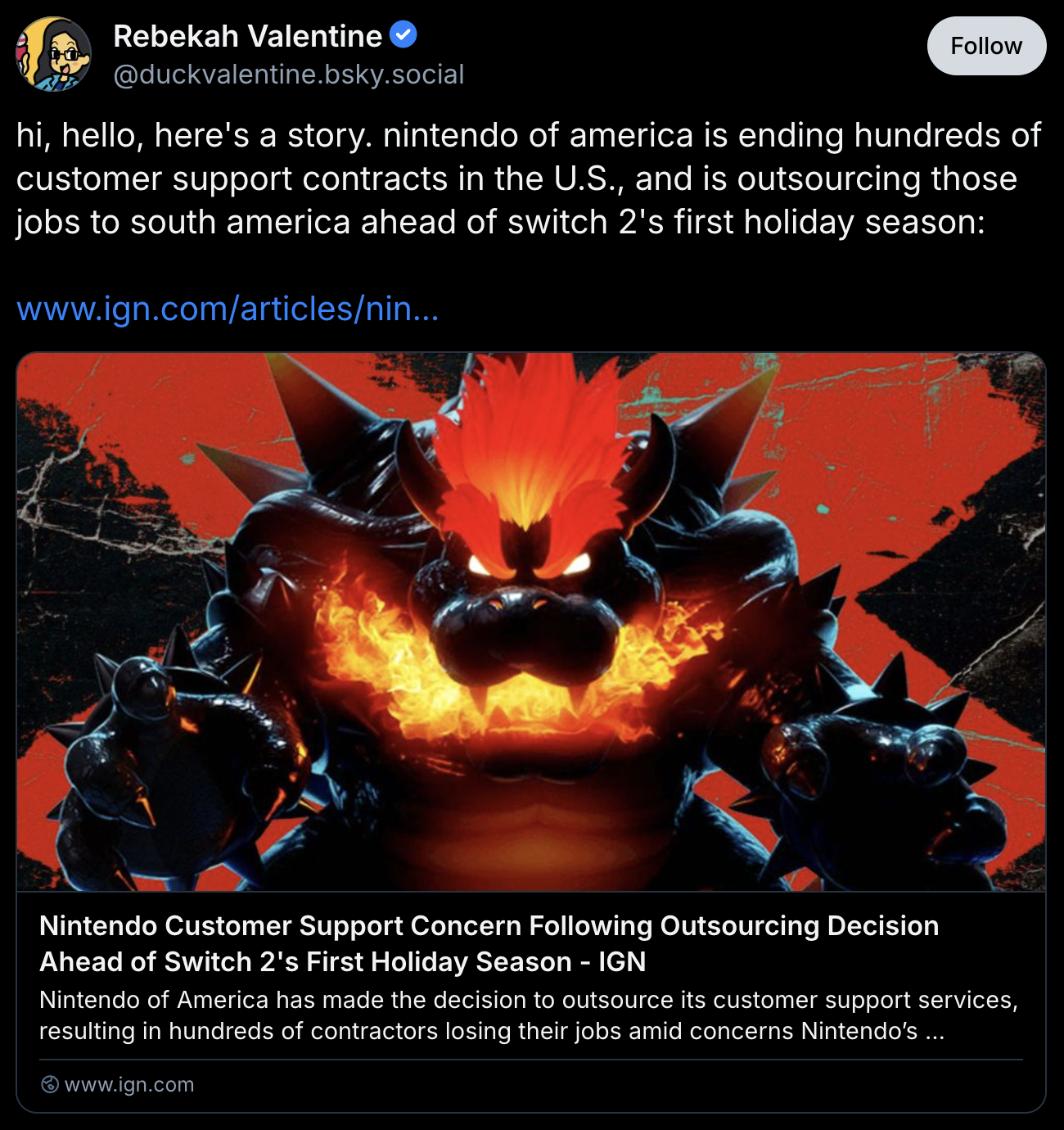
Rebekah Valentine’s reporting is usually on-point, but the framing of this article is frankly off-base. These workers are not employed by Nintendo but the staffing agencies.
This is evident from the facts that the agencies provide their health benefits and “take a cut of the money”. It’s a standard contract staffing arrangement: Nintendo is the client, to which the agency (employer) assigns its contractors. They are on the agency’s payroll, not Nintendo’s.
The claim that Nintendo contracted them for only 11 months a year to avoid converting them to full-time employees also doesn’t ring true. The rate that a client pays to the agency is pre-negotiated, regardless of a worker’s status. So it’s most likely the agency playing the (potentially illegal) trick to maximize its margin.
When a client stops doing business with the agency, it is the agency’s responsibility to reassign the contractors to other clients. Sadly, often there aren’t enough openings, and a number of contractors are thus not retained.
Furthermore, what’s happening doesn’t sound like “outsourcing” either. Outsourcing means that the client hands over an entire function to an outside vendor that operates independently. The report, however, describes direct supervision onsite and an escalation process. This isn’t outsourcing, but either a change of agencies or the same agencies shifting geographical footprint.
Lastly, the article provides no verification of the “hundreds” of terminations claim “estimated” by “multiple sources” who aren’t either the NOA or agency management, and yet IGN chose to put that in the lede.
Again, this post is intended to be only a media critique—no more, no less. I’d like to think that we can champion worker rights and ask for accurate reporting at the same time.
[Originally posted on 2025-09-20 Pacific Time]
