In the real world, when an object speeds away from you, its sound lingers a bit in your ears (human perception, not real). To mimic that in Mario Kart World, the game calculates the relatively speed between you and another kart (img 1), and places the sound source closer to you (img 2).
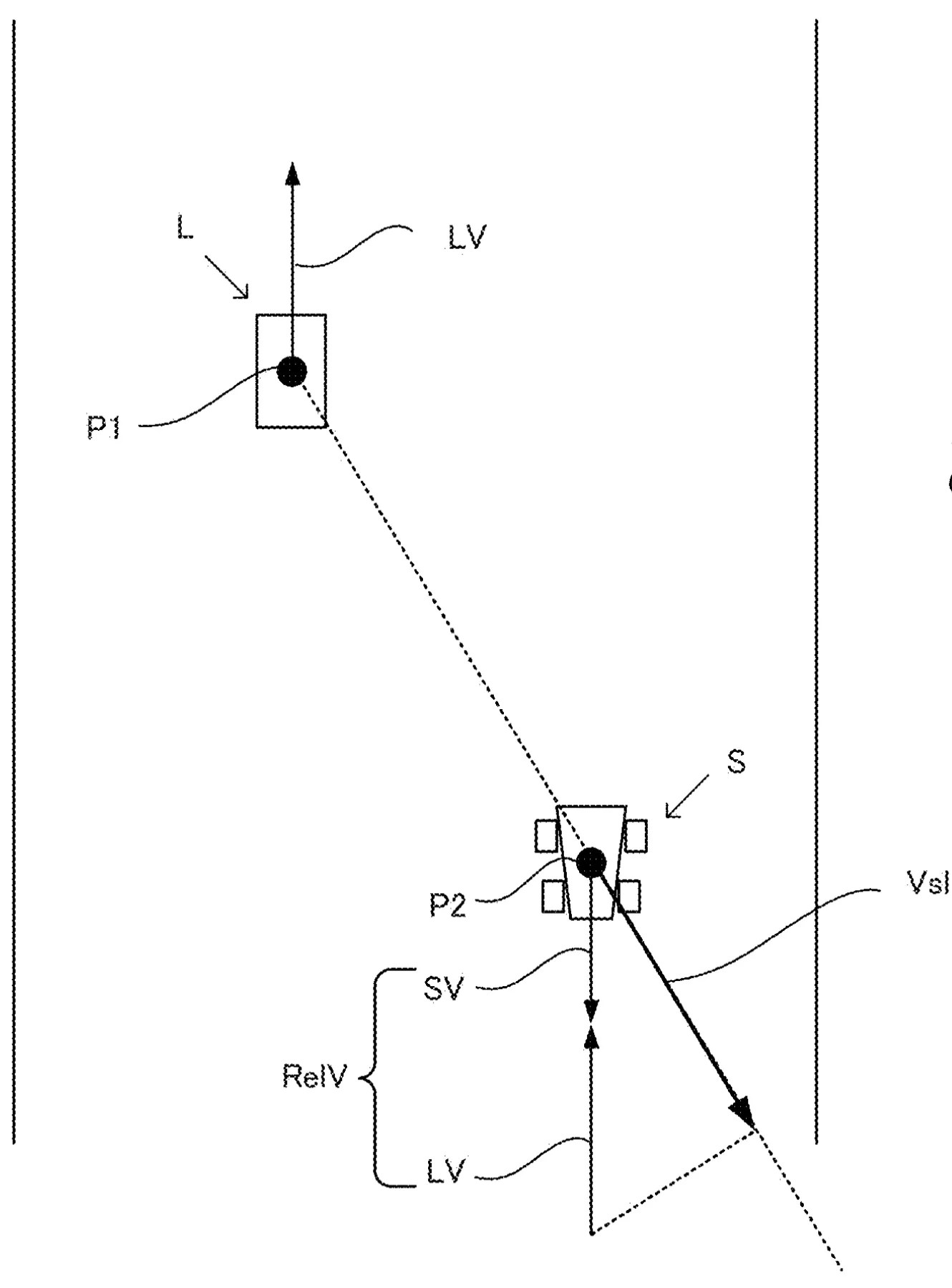
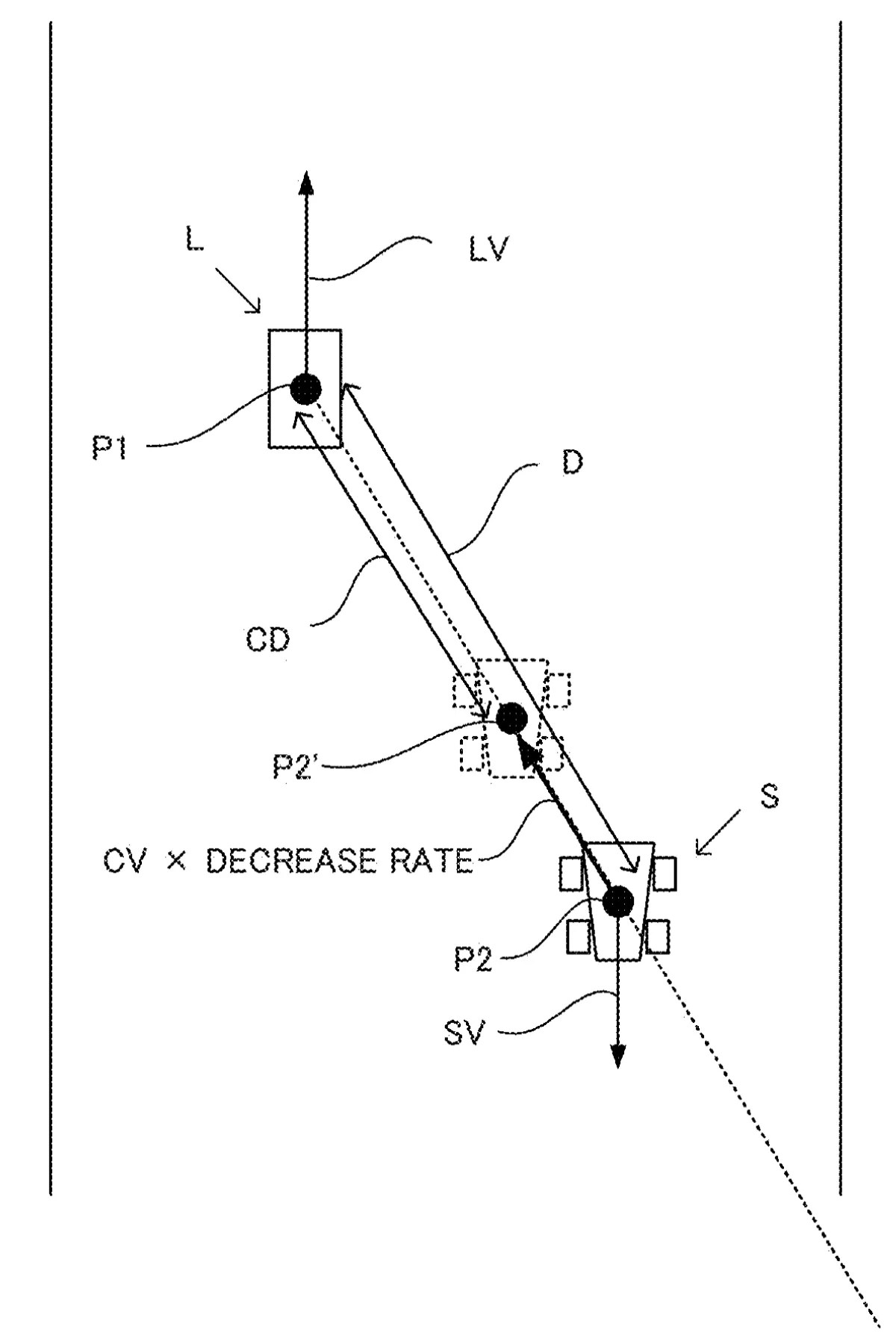
The faster the other vehicle drives away, the more distance reduction is applied to make it sounds closer—hence the lingering perception. Since the formula (img below) takes into account the beginning distance between you, it won’t overcorrect and make a distant kart sounds unnaturally close.
![Excerpt from patent application US 20260175128: [0057] As shown in FIG. 4, first, a relative velocity vector RelV is calculated based on the velocity vector LV of the virtual listener L and the velocity vector SV of the movable object S. The velocity vectors LV and SV have velocity components in the axis directions in the three-dimensional virtual space. Specifically, RelV is calculated based on the following formula (1). [00001] RelV = SV - LV (1) [0058] Next, the velocity at which the movable object S goes away from the virtual listener L is calculated. Specifically, a vector SL from the position P1 of the virtual listener L to the position P2 of the movable object S in the virtual space is calculated, and a component Vsl in a direction along the vector SL of the relative velocity RelV is calculated. Specifically, Vsl is calculated based on the following formula (2). [00002] Vs] = RelV .Math. NSL (2) [0060] Next, a correction value CV obtained by multiplying the calculated direction component Vsl by a coefficient Ratio set in advance is calculated. Specifically, the correction value CV is calculated based on the following formula (3). [00003] CV = Vsl × Ratio (3) [0062] Accordingly, in the exemplary embodiment, the correction value CV is decreased at a decrease rate according to the distance D between the virtual listener L and the movable object S. For example, the decrease rate is calculated based on the following formula (4). [00004] decreaserate = POWER (COEF, -D) (4) [0064] Then, an attenuation reference distance CD is calculated by subtracting the correction value CV decreased at the decrease rate calculated using formula (4) from the distance D. Specifically, the attenuation reference distance CD is calculated based on the following formula (5). [00005] CD = D - (CV x decreaserate ) (5)](https://ninpatentswatch.com/wp-content/uploads/2026/07/bsky-3mpnlniflyk2o-p2-m1.webp)
Related: Mario Kart World enlarges distant objects to improve their visibility
[Originally posted on 2026-07-02 Pacific Time]
